


Restoring Native Grasslands and Riparian Systems in Central Arizona
The Upper Verde Watershed Project brings life back to Arizona’s mountains.
By: Karina Puikkonen
April 22, 2026
Across national forest lands in central Arizona, the landscape tells a unique story about this mountainous desert environment. People once lived with abundant natural resources in the area, as evidenced by the many ancient pottery fragments and homesteading relics found throughout the landscape. That historic bounty has been disappearing.
Once productive grasslands, shaped by historic fire and rich in grasses and shrubs that supported human and animal populations, have now shifted into dense stands of juniper woodlands that can support little else. This is largely because a historic fire regime has been absent for decades. For mule deer and pronghorn especially, that change has meant their transitional ranges have provided less food, less water, and fewer places to rest during herd migrations.
The Mule Deer Foundation (MDF) is working to restore grasslands and riparian areas across this landscape through the Upper Verde Watershed Project. Led by MDF in partnership with the U.S. Department of Agriculture, Forest Service, Arizona Game and Fish Department (AZGFD), and the Salt River Project (SRP), this nearly 8,000-acre project in Prescott National Forest is restoring balance to one of the most important wildlife areas in central Arizona. MDF has a big headstart this year thanks to generous funding support from SRP and AZGFD. Over 1,200 acres were recently treated over the winter, and another 1,200 acres are slated for treatment this spring.
Bringing Back What Mule Deer and Pronghorn Need Most
Located near the headwaters of the Verde River, the project area sits within a high-priority corridor for mule deer, pronghorn, and elk. All these species depend on healthy, connected habitats to survive. Mule deer are the vanishing icon of the west and restoring habitats are key to their recovery.
For mule deer and pronghorn, habitat quality comes down to two essentials: food and cover. In the Upper Verde project area, these essentials have been compromised by decades of fire suppression and expanding juniper woodlands. As juniper trees spread, they crowd out native shrubs and plants that these animals rely on for critical nutrition. Juniper is highly efficient at pulling moisture from the soil, leaving little behind for other vegetation. So, this area has become a landscape with dense woodland cover but very little to eat.
“Juniper trees soak up all the water, and they are more resilient to drought conditions than pinyon pine trees,” Jacob Smith, MDF’s cooperative mule deer biologist with AZGFD said. “They can also withstand the lack of water to a certain degree and spread more quickly, so juniper can change the environment to one in which it can only grow.”
Increasing forage in this area is especially valuable because when water is present, intermittent riparian channels help spread it across the landscape, supporting a diverse mix of shrubs that are highly palatable to mule deer particularly cliffrose, four-wing saltbush, winterfat, and mountain mahogany. Removing juniper trees makes water available to other vegetation, and with added space and sunlight, these shrubs can respond quickly, producing nutrient-rich forage that can sustain deer and pronghorn during their migration seasons.
Building a Mosaic for Wildlife
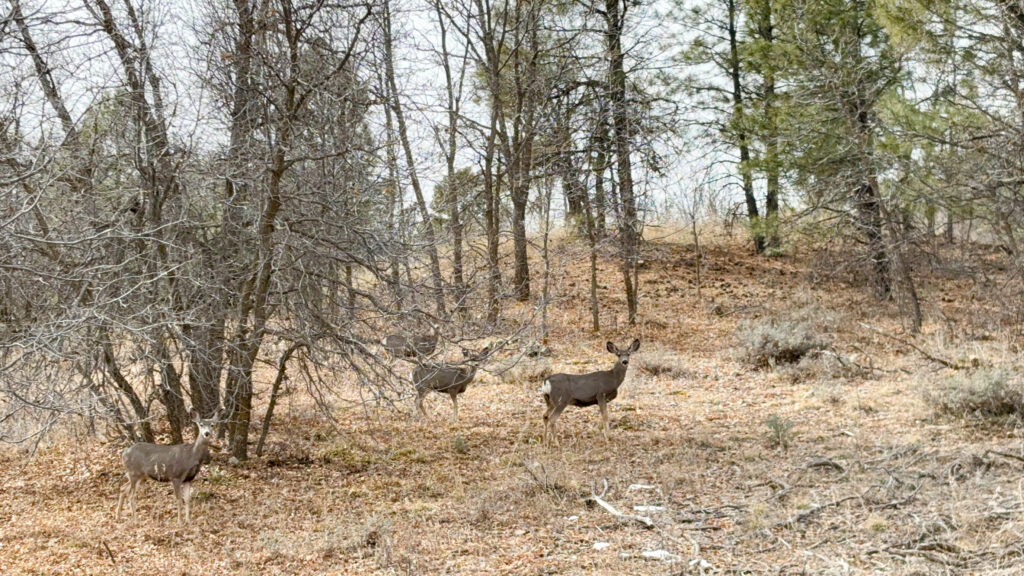
Rather than clearing trees uniformly, this project partnership designed a more nuanced approach, one that mirrors how these systems historically functioned. Crews are creating a mosaic of open lands interspersed with pockets of trees and shrubs. In some areas, clusters of mature pinyon and juniper are intentionally left behind to provide shade, thermal cover, and hiding spaces from predators. In others, wide openings will allow grasses and shrubs to reestablish.
“GPS collars have shown us that pronghorn follow a pipeline through this area because it was the only open country,” Smith said. “If it was more open there would likely be a lot more mule deer too.”
Building this mosaic pattern is especially essential for mule deer. It gives them places to feed, rest, and move safely across the terrain. Early signs from the first project phase are promising. As treatments progressed over the winter, Smith and the crew witnessed increasing wildlife use, including mule deer, elk and small game species that returned to these newly opened habitats.
Water is a Critical Factor in this Project
The benefits of this habitat work for wildlife are clear, but the importance of this project extends even further to the watershed itself. The Verde River is one of Arizona’s most important river systems. In this semi-arid environment, every drop of water to this system matters.
“These riparian areas are opportunistic. There are small and shallow trails filled with rocks that water flows down.” Smith said. “When a good rain comes through, water really moves in this area.”
By removing the juniper encroachment to grasslands, this project will help the land function more like a sponge. Grasses, forbs, and shrubs slow runoff, stabilize soils, and trap sediment, allowing water to seep into the ground rather than wash away. Even small, rocky drainages often dry for much of the year benefit from this increased stability when summer monsoon rains arrive.
While the area has experienced some record hot and dry conditions this spring, the crews experienced rain delays during the winter that made the road impassable at times. A testament that this area will take water when it can.
Reducing Wildfire Risk to Communities
While this project rebuilds vegetation communities, it also reduces wildfire risk by removing extra woody fuels. Overgrown woodlands supply heavy fuel loads that are more prone to high-severity fires, especially around the communities SRP serves and the power infrastructure this energy company maintains.
“This is an important wildland-urban interface area,” Smith said. “We go through a neighborhood to get to the project area.”
Historically, fire would have moved through this landscape every 10 to 30 years, and bringing fire back at intervals can maintain the open grasslands and prevent future tree encroachment. The hope is that this partnership can bring back beneficial natural fire regimes by safely reintroducing prescribed fire to a healthier landscape.
The Upper Verde Watershed Project helps this partnership achieve multiple goals. Improving habitat supports healthier mule deer populations and grows more deer, while woodland thinning creates healthier and more resilient landscapes. At the same time, watershed improvements help provide reliable water and power to central Arizona communities. By restoring watershed function and reducing the risk of catastrophic wildfire, the landscape can once again become a bountiful home to wildlife and modern civilizations that still depend on these natural resources.
Top image: Image used under license from Shutterstock.com


