


Understanding Deer Migration and Habitat
We all know that deer move a lot across our vast western landscapes and that seasonal habitat like winter range is a critical part of their annual lifecycle. These movements, often called migrations, can be obvious or not so obvious depending on time, route, and number of animals using a certain area. Historically, deer managers relied on professional observation and historic records to identify these movement and migration routes but lacked specific information on how many animals used certain routes, how the routes were used by moving animals, and how animals reacted to impacts to these routes. However, over the last decade, scientific knowledge has increased dramatically about how significant migrations are to the health of mule deer and black-tailed deer herds.
Policy Development and Conservation Efforts
Conservation efforts to improve big game migration corridors and seasonal ranges in the West took a major leap in February 2018, when then-Secretary of the Interior Ryan Zinke signed Secretarial Order 3362 at MDF’s Western Hunting and Conservation Expo. In the first two years of the SO 3362 implementation, the U.S. Department of the Interior and partners like MDF facilitated 73 projects across 11 states with more than $47 million being invested from federal and matching grants in state-identified priority research projects, data analysis and mapping assistance, habitat-related projects, and other activities. Even more work has happened on the ground since the first progress report was released in 2020.


MDF’s Leadership and Initiative in Habitat Conservation
Shortly after SO 3362 was signed, MDF created its Winter Range and Migration Corridor Initiative, to assist with the implementation of the order and to partner with agencies, landowners, and others to ensure conservation of these important areas. MDF has been a leader in both the policy efforts to implement the secretarial order as well as coordinating habitat conservation and restoration efforts. Making sure that mule deer and black-tailed deer have quality habitat in the areas where they need it the most throughout the year will always be a top priority for our organization. Since the inception of the Winter Range and Migration Corridor Initiative, MDF has received over $2 million in grants to help with capacity and on-the-ground projects.
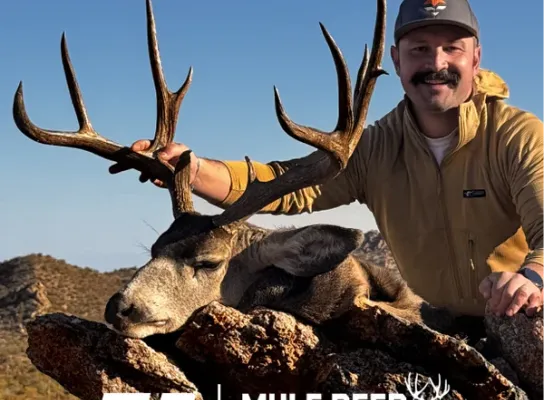
Win Sonora, Mexico Mule Deer Hunt
The Mule Deer Foundation is proud to share an incredible opportunity for those who dream of hunting the legendary giants of Sonora, Mexico. Known for producing some of the biggest mule deer bucks in North America, Sonora offers the perfect combination of rugged desert landscapes, prime winter rut timing, and expert local guides who know exactly where to find world-class animals.

MDF hires Sarah Meronk as a project manager in western Montana
I earned my bachelor’s degree in Wildlife from Purdue University in 2016, then spent several years working seasonal field technician jobs, primarily capturing and collaring elk and mule deer, and conducting vegetation surveys to assess habitat conditions. In 2019, I moved to Salmon, Idaho, where I worked for Idaho Fish and Game, first as a big game population technician, monitoring collared big game, and later as a depredation technician, working with landowners to mitigate wildlife conflicts.

MDF Hires Regional Conservation Coordinator based in Utah
Katie was born and raised in NE Kansas with a passion for the outdoors and wildlife. She followed this passion in her educational career, graduating from Benedictine College with a bachelor’s in biology and then completing her master’s degree at the University of Kansas in ecology and evolutionary biology. She worked for the Utah Division of Wildlife Resources for two years working with private landowners to further conservation of land and wildlife habitat.

Transportation Technical Assistance Liaison – Idaho
The Mule Deer Foundation (MDF) and Idaho Fish and Game Department are seeking a highly motivated and dedicated individual to fill the role of Transportation Technical Assistance Liaison to support IDFG with providing biological technical assistance to ITD. In this role, you will be a critical member of an interagency team supporting ITD’s programs and projects with a nexus to fish, wildlife, and botanical resources. This position will provide leadership and creativity for exploring and implementing solutions to benefit both conservation and society’s transportation needs.